In 2008, when Alexander Acosta – then U.S. Attorney for the Southern District of Florida – signed the secret non-prosecution agreement with Jeffrey Epstein, he likely never imagined that signature would become one of the most infamous stains in the history of the U.S. justice system. That deal didn’t merely spare Epstein from prosecution on dozens of counts of sexually abusing underage girls; it granted blanket immunity from federal charges to any “potential co-conspirators” – a clause almost unprecedented in serious criminal cases.
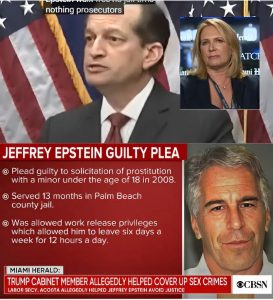
Dozens of victims – mostly teenage girls lured into Epstein’s lavish properties – were robbed of their chance at justice. Instead of facing a public trial and decades in prison, Epstein received a lenient sentence: 13 months in jail (served only 11 months with a special “work-release” arrangement allowing him to leave for 12 hours a day). In exchange, he agreed to “cooperate” – yet he provided no meaningful information about the powerful figures who had entered his orbit.
The case exploded into public view again in 2018–2019 thanks to the Miami Herald’s groundbreaking investigation, particularly Julie K. Brown’s “Perversion of Justice” series. Only then did the public learn the 2008 deal was sealed in secret, without notifying victims – a clear violation of their rights under federal law (the Crime Victims’ Rights Act). When questioned years later (after serving as Secretary of Labor under Trump), Acosta claimed he believed Epstein would face harsher treatment at the federal level and that the deal was the best way to “protect victims.” Internal documents and testimony from other prosecutors, however, reveal intense pressure from Epstein’s legal team – one of the most formidable in the country – forced Acosta’s office to back down.
The biggest question still lingers: who really stood behind this agreement? Epstein didn’t operate alone. His circle included former presidents, royalty, billionaires, and high-ranking politicians. Granting immunity to “any co-conspirators” is widely seen as a deliberate shield for names too explosive to expose. When Epstein was rearrested in 2019 and later died in custody (officially ruled suicide, though conspiracy theories abound), the case seemed closed – yet the legacy of Acosta’s signature endures.
In 2020, under mounting public pressure, Acosta resigned as Labor Secretary. Still, not a single “potential co-conspirator” has ever been prosecuted under the 2008 deal. Victims continue pursuing civil lawsuits, but criminal justice – the kind that puts people behind bars – was strangled in 2008.
The Epstein–Acosta scandal isn’t just one man’s mistake. It lays bare how the justice system can bend when confronted with wealth, power, and connections. One signature saved a network of predators, silenced dozens of victims, and forced Americans to ask: Is justice truly blind, or does it only pretend to be when it suits the powerful?
Leave a Reply