China’s Digital Silencing: The Disappearance of Whistleblower Lin Beichuan in the Yu Menglong Case
In the wake of Chinese actor Yu Menglong’s mysterious death on September 11, 2025—officially ruled an accidental fall from a Beijing high-rise—a former soldier named Lin Beichuan emerged as one of the most vocal challengers to the official narrative. Identifying himself as a “Red descendant” (a term denoting revolutionary family lineage) and retired military veteran, Lin publicly accused a senior public security official of protecting those responsible for what he called Yu’s “suspicious murder.” His Weibo posts, which included real-name revelations and photos, quickly reached high levels of the Chinese Communist Party before being erased by censors.
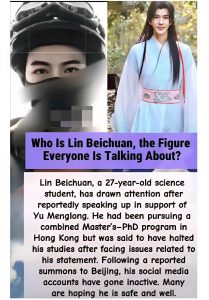
Lin’s involvement began shortly after Yu’s death, when he questioned police procedures on social media, refusing to sign what he described as a coerced “agreement” to stay silent. By late October 2025, he posted explosive allegations naming Public Security Minister Wang Xiaohong as the “artery” of a cover-up shielding elite suspects. Supporters praised his courage—”Lin Beichuan lives up to his name: righteous and unyielding”—while expressing fears for his safety. On November 2, he shared his GPS location from Beijing’s Andersen Garden complex (near the death site) with a cryptic message: “Meeting some people I should meet. Not here on my own.” Contact ceased shortly after.
Reports from Vision Times and online forums indicate Lin faced Beijing summons, threats, fabricated charges, and vicious online slander targeting his martyr parents’ legacy. His accounts were deleted, and family members (including an uncle at the National People’s Congress) were reportedly questioned. By mid-November 2025, he had vanished, with insiders warning he could become a “scapegoat” in a broader suppression effort. No official confirmation of his status exists, and domestic discussion remains blocked.
The Yu Menglong case itself—ruled non-criminal despite leaked autopsy claims of torture, sexual assault, and organ damage—has fueled over 640,000 signatures on global petitions demanding independent probes. Allegations include elite involvement (princelings, officials), a botched investigation, and body mishandling (possible formalin preservation at a Beijing museum). Lin’s advocacy amplified these, turning a celebrity tragedy into a symbol of systemic opacity and repression.
Observers see parallels to past cases where whistleblowers face “disappearance” or forced confessions under China’s tight information controls. The government’s swift closure—no criminal probe, mass content removal (over 100,000 posts deleted on Weibo)—highlights distrust in official accounts. Lin’s military background and revolutionary lineage made his defiance particularly resonant, exposing fractures in narratives of loyalty and justice.
As international attention grows (via Avaaz, Reddit, and overseas media), the question lingers: Can voices like Lin’s survive in a landscape where truth-seeking invites erasure? Without transparent accountability, the Yu Menglong saga—and Lin Beichuan’s fate—risk becoming another chapter in China’s unresolved quest for justice.
Leave a Reply