MYSTERIOUS CASE OF THE 13-YEAR-OLD HENAN SCHOOLBOY: EERIE NEEDLE MARKS AND HAUNTING ECHOES OF THE YU MENGLONG TRAGEDY
Zhumadian, Henan, February 27, 2026 – The unresolved mysteries surrounding actor Yu Menglong’s death in September 2025 had barely begun to fade from public memory when, in early 2026, another shocking incident struck: a 13-year-old boy named Zhu was found dead in his dormitory at Jinshi Qinghuayuan School in Xincai County, Henan Province, his body bearing mysterious needle marks on his chest. These small but chilling puncture wounds quickly spread across social media, igniting widespread suspicion and forcing millions to ask: Is this merely a tragic coincidence, or the terrifying first sign of a darker pattern emerging—eerily reminiscent of the layers of doubt that still surround the Yu Menglong case?
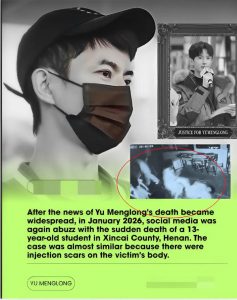
According to the official statement issued by the Xincai County joint investigation team on January 11, 2026, the boy was discovered unresponsive in his dorm around 6:00 a.m. on January 8. No prior conflicts, illnesses, or unusual behavior were reported. Full autopsy and toxicology tests ruled out external injury, poisoning, or assault. The cause of death was officially determined as “cardiogenic sudden death”—a rare but documented condition in adolescents. The puncture mark on the left chest? Authorities explained it as a postmortem needle insertion for cardiac blood sampling during forensic toxicology analysis; the red fluid at the mouth was described as natural bodily fluid leakage during handling of the remains.
Yet these official explanations have done little to calm the storm of public outrage. Family members recounted receiving a vague notification (“the child is gone”) before rushing to the school, only to find an unmarked ambulance already attempting to remove the body—reportedly headed to a distant facility rather than the nearest local hospital. A tense confrontation erupted at the school gate, drawing hundreds of parents and local residents demanding answers. Photos of the puncture wound—described online as “nail-sized” or “injection-like,” accompanied by bruising—rapidly went viral, reviving fears of forced medical procedures, organ-related screening, or foul play within school premises.
Social media erupted with direct comparisons to the Yu Menglong case: two high-profile deaths separated by only a few months, both swiftly labeled “accidental” or “natural,” both marred by malfunctioning surveillance cameras, rapid scene cleanup, and restricted family access. Hashtags such as #JusticeForZhu and #EchoesOfYuMenglong trended intensely, even though no concrete evidence links the two tragedies. Many users called the needle marks a “silent scream” connecting the cases, fueling deep-seated fears of hidden threats lurking beneath the surface of everyday institutions.
Authorities responded decisively: police were deployed to disperse gatherings, the case was reaffirmed as non-criminal, and warnings were issued against spreading rumors. The January 11 bulletin stressed respect for the deceased and the grieving family while threatening legal action against misinformation. State media outlets such as China Daily and Phoenix Net reiterated the cardiac conclusion without delving into the controversy.
For the victim’s family and a deeply shaken public, this incident exposes profound anxieties: school safety, the handling of child fatalities, and perceived lack of transparency from institutions. Overseas Chinese-language sources (Vision Times, Taiwanese media) reported on alleged suppression, temporary “disappearance” of family members (unverified), and renewed links to organ-harvesting allegations—though no specific evidence ties this case to such claims. Domestically, thousands of posts were deleted and accounts suspended for “causing instability.”
Just as Yu Menglong’s death once drew over 600,000 petition signatures demanding justice, the needle marks on young Zhu are now reigniting a similar wave of calls for truth. Despite the firm official stance that this was a natural tragedy, the haunting images continue to circulate, transforming private grief into a collective demand for answers. Is this isolated heartbreak, or the beginning of something far more sinister? The public remains unwilling to let the question fade into silence.
Leave a Reply